

In 1946, American astronomer Lyman Spitzer published a paper discussing the advantages of a space-based telescope over ground-based telescopes. This was the idea that later gave rise to one of the most successful telescopes ever built – the Hubble Space Telescope (HST).
Launched in 1990, the HST features a 2.4m primary mirror and observes the universe at the ultraviolet, optical, and near-infrared regions (10 nanometres to 3300 nanometres) of the electromagnetic spectrum. To date, it has made more than 2 million observations.
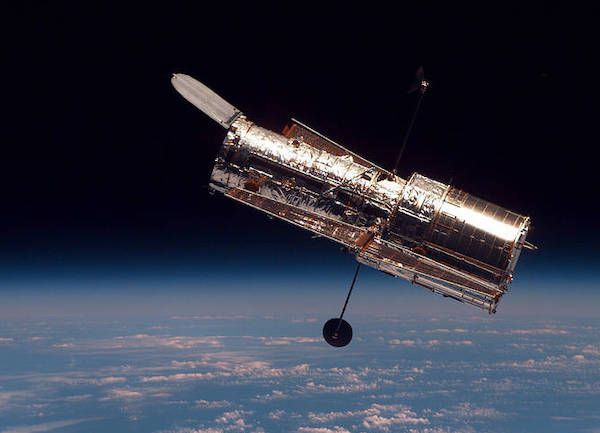
The Hubble Space Telescope. Source – NASA
However, in the last few years, the public’s attention has shifted to the James Webb Space Telescope (JWST). Colloquially dubbed the successor to the HST and the Spitzer Space Telescope, the JWST was first proposed in 1996 and eventually launched in 2021. Its primary mirror has a diameter of 6.5m, and it observes from long-wavelength visible light through mid-infrared light (0.6 to 28.5 microns).
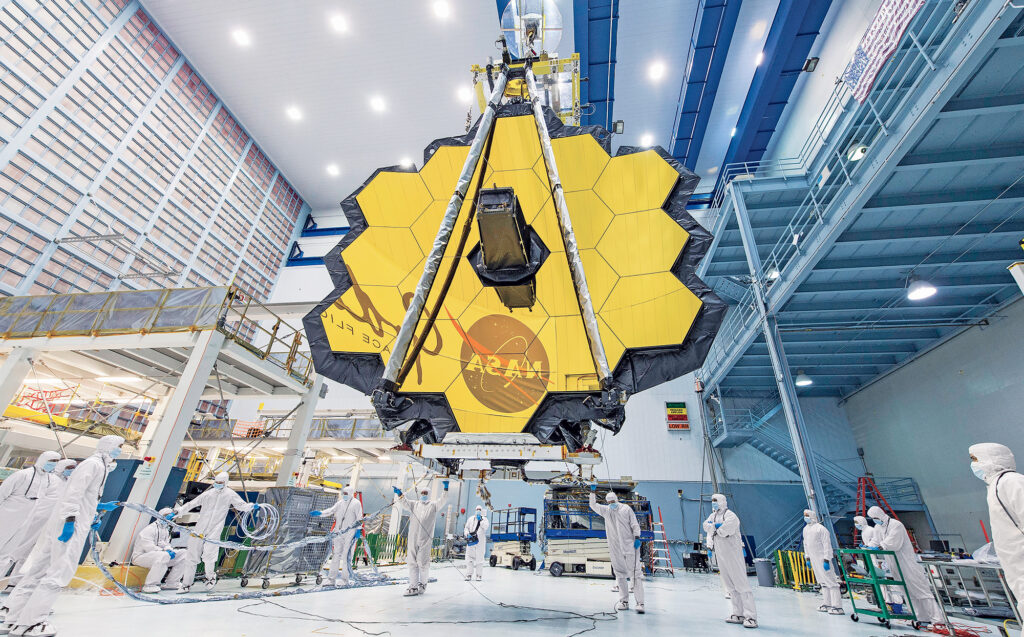
The James Webb Space Telescope. Source – C&EN
With the obvious technological improvements – such as the 25 square meters collecting area – the JWST is clearly a better telescope than the HST. But, is it too soon to write-off a veteran telescope that is still functional? Has JWST outdone HST in every aspect, or can the HST still provide valuable information about the cosmos?
Telescopes are tools that look into the past
The fastest messenger to carry information from point A to B is electromagnetic waves, or light. It travels at a finite speed, and takes a finite amount of time to reach point B. An observer sitting at point B will observe point A as it was when it emitted the light.
For example, let’s suppose point A is the Sun and B is the Earth. Then, it takes light approximately 8 minutes and 20 seconds to travel from A to B. When you look up in the sky, you are actually seeing the Sun as it was 8 minutes and 20 seconds ago. The nearest star to our solar system, Proxima Centauri, is 4.25 light-years away. When a telescope, on Earth, records its light, it’s actually recording the state of the star as it was 4.25 years ago.
Now, the expansion of the universe leaves a significant imprint on the light that B receives. As the wave travels through the space between points A and B, it loses energy and its wavelength increases. It gets stretched. This is called cosmological redshift, or simply redshift. This effect shifts the spectral lines seen in a galaxy’s spectrum towards the redder side of the electromagnetic spectrum. Since the shift corresponds to the distance between us and the observed galaxy,
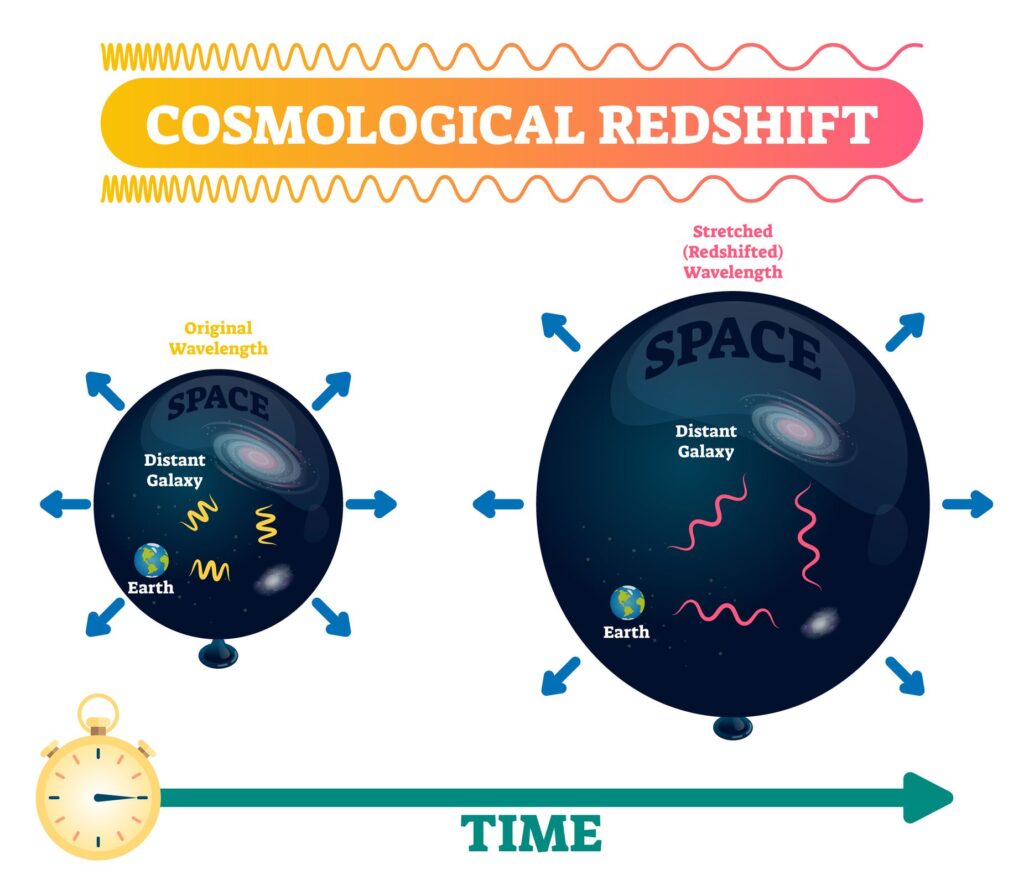
Illustration of cosmological redshift. Source – Cosmos At Your Doorstep
The shift in the spectral lines corresponds to the distance between us and the observed galaxy. It tells us how far away the galaxy is from us. And since light’s speed is finite, this distance then tells us the age of the galaxy when it released that light.
The higher the redshift of a galaxy, the younger it was when it released the electromagnetic wave.
The Complementary Roles of HST and JWST
One primary use of telescopes with large mirrors is to look at a patch of sky and collect data. The longer they look, the more data they will collect and the deeper they will look back in time. Studying the properties of galaxies found in such deep field images helps us understand the formation and evolution history of galaxies. This is one of the main scientific goals of huge telescopes like the HST and the JWST.
The Hubble Space Telescope has been instrumental in studying galaxies at redshifts of 3 and below. That translates to approximately 2 billion years after the Big Bang.
Note – This value heavily depends upon the cosmological model and its parameters used. The value of 2 billion years cited here comes from a standard cosmological model and can be calculated from this online calculator here
This is the time period when the star formation rates of galaxies were at their peak. Star forming regions release large amounts of UV and blue light. At redshifts of 2-3, this light gets redshifted to red and near-infrared light (~800 nanometres to 3000 nm). The HST was designed to observe this wavelength range. This has unveiled a myriad of secrets about galaxies. One good example is that it revealed how galaxies grew from small clumps into structured systems.
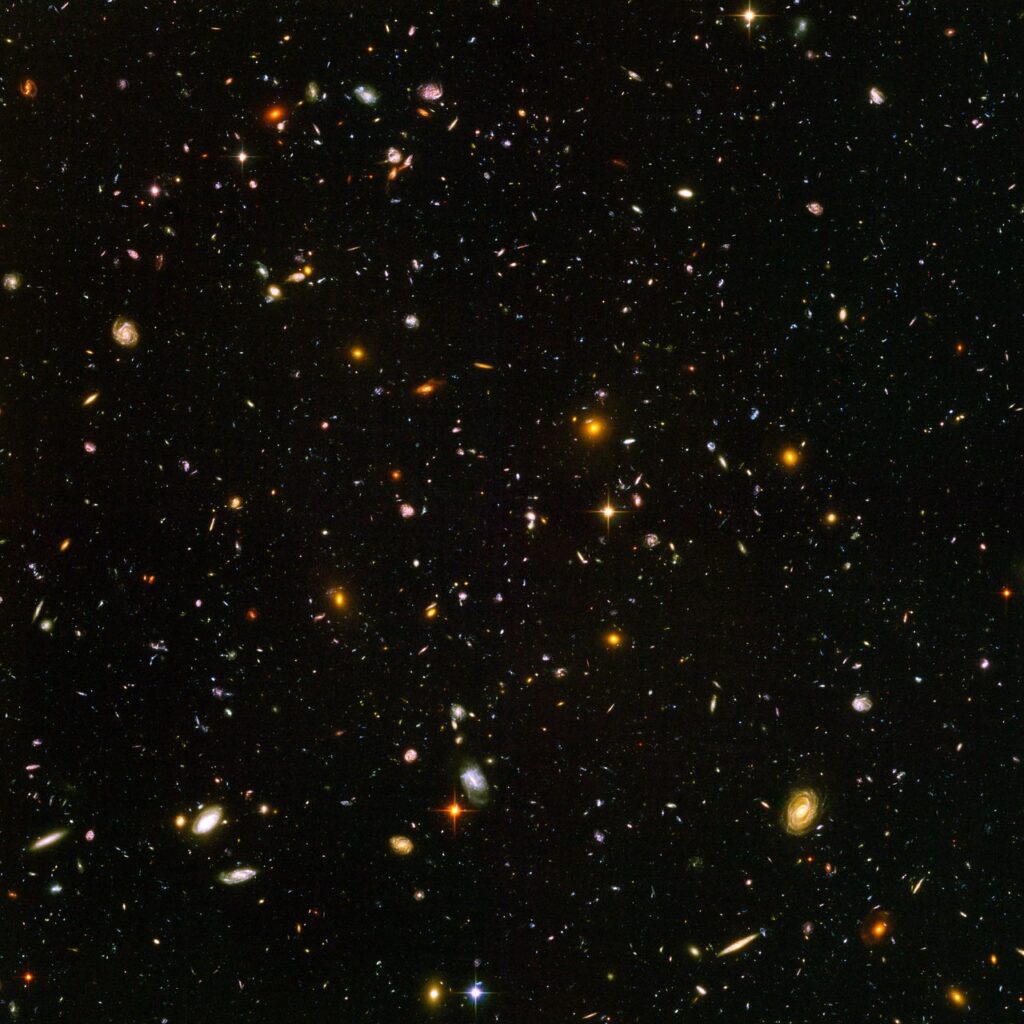
This view of nearly 10,000 galaxies is called the Hubble Ultra Deep Field. The snapshot includes galaxies of various ages, sizes, shapes, and colours. The smallest, reddest galaxies, about 100, may be among the most distant known, existing when the universe was just 800 million years old. The nearest galaxies – the larger, brighter, well-defined spirals and ellipticals – thrived about 1 billion years ago, when the cosmos was 13 billion years old. Source – https://esahubble.org/images/heic0611b/
The James Webb Space Telescope, on the other hand, was designed to observe the universe at redshifts of 10-13, i.e., when the universe was 300-500 million years old. The UV light emitted at this time gets redshifted to mid and far-infrared, which is a wavelength range that the JWST can observe but the HST cannot.
It has detected the first galaxies of the universe and revealed some astonishing properties. Contrary to most models about galaxy evolution, these early galaxies were massive and formed stars at high rates.
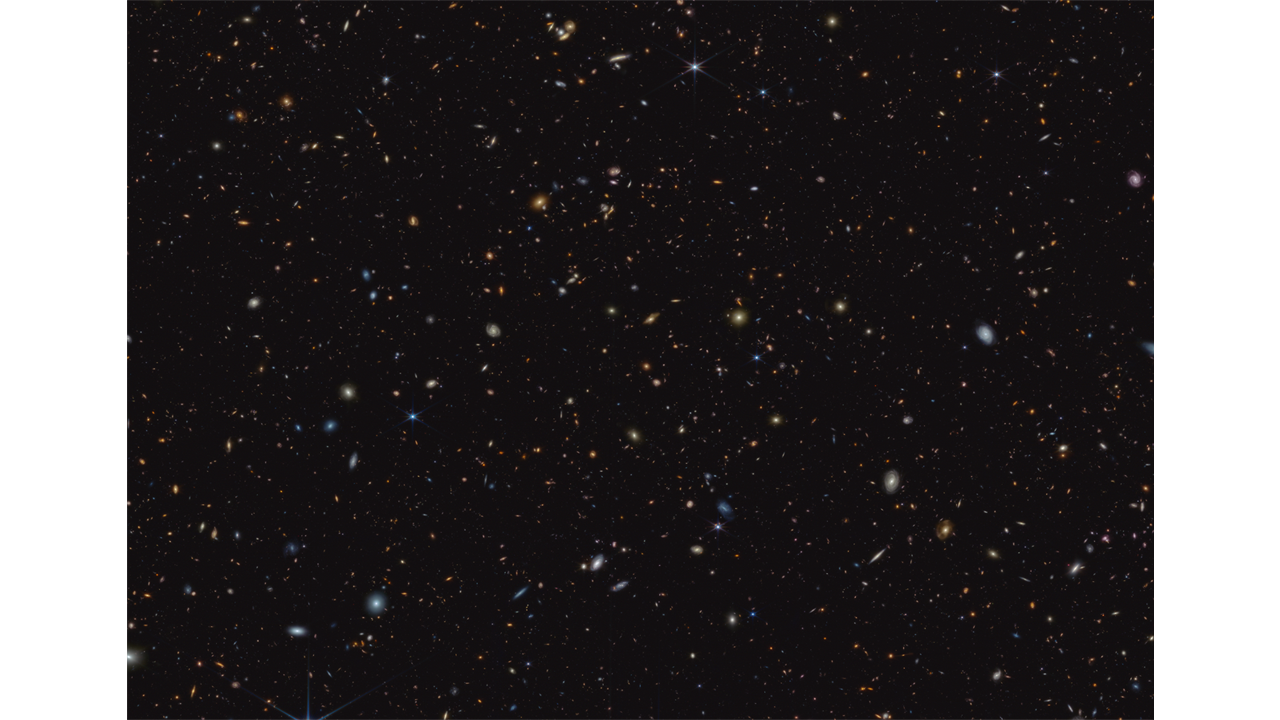
This infrared image from NASA’s James Webb Space Telescope (JWST) was taken for the JWST Advanced Deep Extragalactic Survey, or JADES, program. It shows a portion of an area of the sky known as GOODS-South, which has been well studied by the Hubble Space Telescope and other observatories. More than 45,000 galaxies are visible here. Source – https://webbtelescope.org
When combined, the HST and the JWST cover a broad redshift range and provide a holistic view of galaxy formation and evolution. This helps refine our theories of galaxy formation and the large-scale structure of the universe.
Aside from galaxies at different redshifts, these two telescopes complement each other while studying stars and stellar populations as well. Young stars are hot, bright and emit copious amounts of UV and blue light. They dominate a galaxy’s total light intensity. Additionally, dust absorbs UV and optical light and emits infrared light. A cluster of young stars enveloped in dust will appear bright in the infrared light rather than in UV. Old stars, which emit red and infrared light, are dim and cooler but contribute the majority of a galaxy’s mass.
When studying the Milky Way or galaxies in the local universe, the HST excels at observing young stellar populations. The JWST is useful in studying old stars or dust-obscured regions. Combined, they probe important parts of a galaxy and help develop a richer and more informed view.
In conclusion, despite the higher technological prowess of the JWST over the HST, the veteran telescope observes a crucial part of our universe’s history. Instead of debating whether the new can replace the old, the conversation should be about how the two can complement each other and reveal more mysteries of the universe than either could have uncovered alone.
